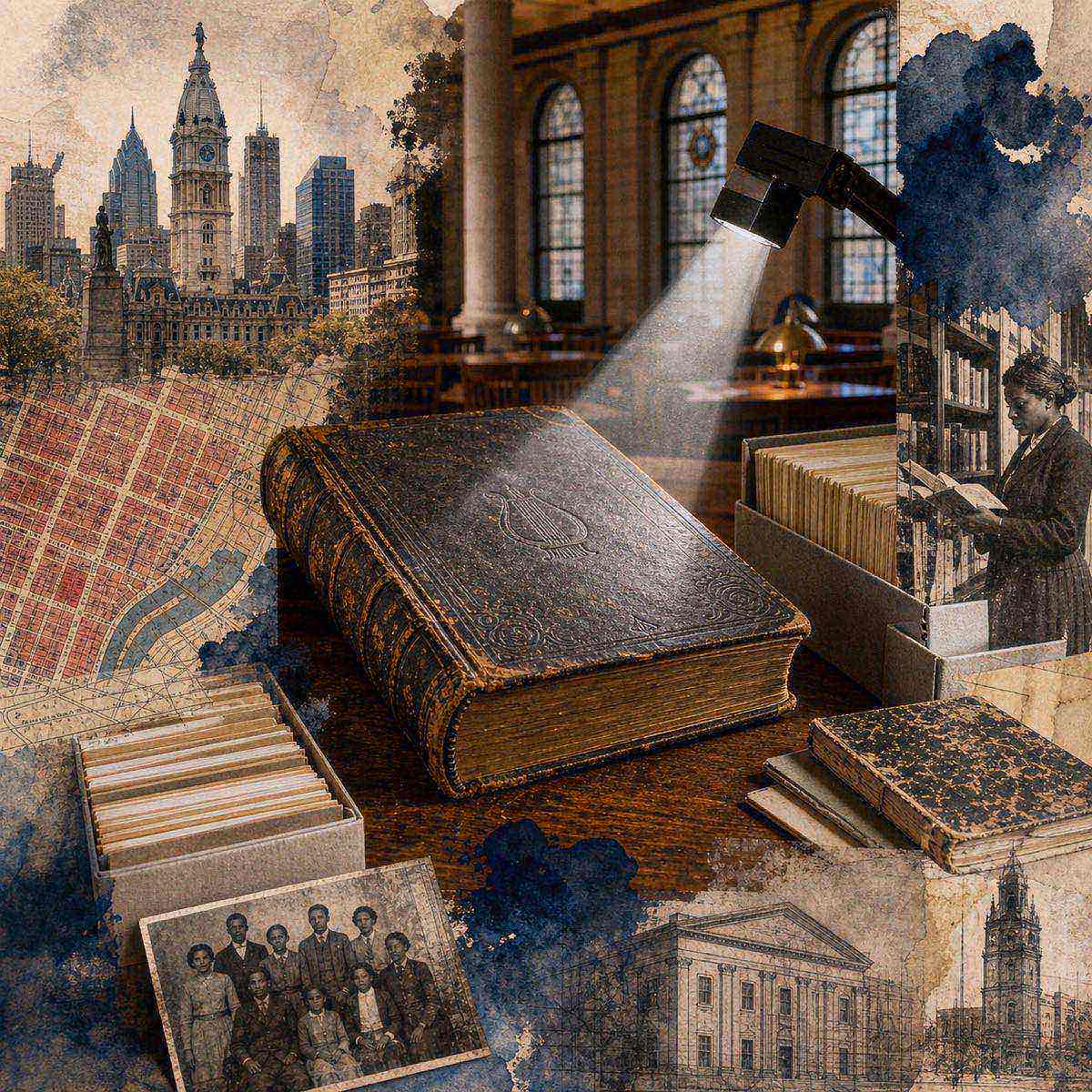
On Philly Tours’ Library Story Hop Tour, one stop is less a building than a promise: the Charles L. Blockson Collection in Sullivan Hall at Temple University—an archive Temple describes as one of the nation’s leading research facilities for the history and culture of people of African descent. (Temple University Libraries: Blockson Collection overview)
In the Collection’s public storytelling, one such “hero object” has been a small hymnbook owned by Harriet Tubman—the kind of personal, working artifact that turns a larger-than-life figure into a person who carried something in her hand. Temple has featured that hymnbook in Women’s History Month programming and campus coverage for years. (Temple Now: Blockson Collection Women’s History Month)
The civic lesson isn’t just about Tubman. It’s about what it takes for an artifact like that to survive long enough to teach anyone anything.
The fore-story: collecting as a form of civic work
Charles L. Blockson’s life story is often told as a counter-argument to historical disappearance: if institutions did not reliably preserve Black history, then someone would have to build that archive anyway—item by item, shop by shop, story by story.
Temple’s Africology and African American Studies program describes the Collection as a major national resource and quotes Blockson’s own motivation bluntly: “knowledge is a form of Black power.” (Temple College of Liberal Arts: Blockson Collection)
That line works as a slogan—but it is also a practical description of the stakes. If a community’s records are scattered, underfunded, locked behind paywalls, or lost to neglect, the community’s ability to argue for itself in public life shrinks. Archives are not neutral basements. They are civic infrastructure.
The Blockson Collection’s own “how to use it” language makes that plain. Temple notes that the collection must be used in-house, and it solicits endowment support to “preserve and improve accessibility” for future generations. (Temple University Libraries: Blockson Collection overview)
Read that carefully: preserve and access are two different jobs.
The civic bridge: in 2026, “access” increasingly means “digitized”
For most Americans, “research” no longer starts in a reading room. It starts in a search box. And for many school assignments, community projects, family-history questions, and civic debates, an archive is effectively invisible until it is scanned, described with good metadata, and made findable online.
Temple’s digital collections portal describes its mission in exactly those terms: free worldwide access to unique primary resources held by the Libraries, including materials from the Blockson Collection. (Temple Libraries Digital Collections: Explore Collections)
That’s the hopeful part. The hard part is that digitization isn’t just a scanner problem. It’s also a policy problem:
- Who pays for the labor of scanning and description?
- What rights does an archive have (and not have) to reproduce and share what it holds?
- When digitized materials circulate, who benefits—and who can be exploited?
Those questions got sharper in the last few years because digitized archives aren’t only used by students and historians. They are also used at industrial scale as inputs for machine-learning systems.
The current context: the federal government is signaling that “mass digitization” now includes AI
In May 2025, the U.S. Copyright Office released a pre-publication version of Part 3 of its multi-part report on “Copyright and Artificial Intelligence,” focused on generative AI training, and said a final version will be published later (without substantive changes expected). (U.S. Copyright Office: Copyright and AI report hub, Part 3 PDF (pre-publication))
For archives, that matters because digitization has been framed as an unambiguous public good. The AI era complicates that story. A scan that helps a student can also become training data for a commercial system that doesn’t credit the archive, doesn’t share the value created, and may even reduce web traffic that supports institutional visibility.
At the same time, the underlying issue is older: archives have always faced the tension between public access and resource constraints. AI simply scales the consequences.
Funding is policy: grants decide what gets scanned, and what stays “in-house”
If digitization is civic infrastructure, then public funding is one way the public chooses what parts of history stay reachable.
In January 2026, the Institute of Museum and Library Services (IMLS) announced it was accepting applications for its FY26 discretionary grant cycle, describing IMLS as the leading source of federal funding for American museums and libraries. (IMLS press release, Jan. 13, 2026)
That kind of funding shapes what the public can actually reach. When money is scarce, institutions make rational choices: scan what’s easiest or most requested, prioritize grant-shaped projects, and keep fragile materials in-house because staff time is finite. The default future of archives is uneven—some stories become searchable and linkable, while others remain physically safe but digitally silent.
A reader takeaway: digital access needs rules, not just scanners
The Blockson Collection is a powerful Philadelphia example because it sits at the intersection of three realities: what gets saved shapes what can be argued for today; access depends on staffing and preservation; and digitized history can educate the public while also being mined for profit. The public-policy question for 2026 isn’t “Should we digitize?” It’s: What rules and funding should govern digitization so access expands without turning community history into a free raw-material stream?
The U.S. Copyright Office’s AI work suggests we’re entering a period where those rules may become clearer. That is an opening for cities, universities, and libraries to insist on fairer terms: stronger licensing options, clearer “permitted use” framing, and more investment in public-serving digitization.
Route connection: visit the reading room—and notice what isn’t online
At the Charles L. Blockson Collection stop on Philly Tours, you’re not just near a university archive. You’re near a civic workshop where public memory is built and maintained.
If you visit, pay attention to two things at once:
- the thrill of the artifact itself—something as intimate as a hymnbook linked to Harriet Tubman
- the practical barriers that decide who can learn from it: hours, staffing, preservation rules, and whether the material is digitized
American history is full of bold ideas about freedom and citizenship. The Blockson Collection reminds you that those ideas depend on something quieter: whether the evidence of people’s lives is preserved, described, and made reachable to the next reader.